Walk into any "eco-friendly" packaging exhibition in India and you'll hear the same pitch: "Our cups are PLA-coated — completely plant-based, 100% compostable." It sounds convincing. It's also misleading.
What Exactly Is PLA?
PLA stands for Polylactic Acid. It's a polymer derived from fermented plant starches — usually corn, sugarcane, or cassava. The process involves converting plant sugars into lactic acid, which is then polymerized into long-chain molecules that can be molded into films, containers, and coatings.
Because the raw material is plant-derived, PLA has been aggressively marketed as "bio-plastic" or "plant-based plastic." Packaging companies use this origin story to position PLA products as environmentally responsible alternatives to conventional polyethylene (PE) coatings.
The Molecular Reality: PLA Is Still a Plastic
Here's what the marketing leaves out: regardless of its plant origin, PLA is a synthetic polymer. Its molecular structure — repeating chains of lactic acid monomers — classifies it as a thermoplastic polyester. The European Chemicals Agency (ECHA) and the EU Single-Use Plastics Directive both classify PLA as a plastic material.
The source of carbon atoms (corn vs. petroleum) doesn't change the fundamental polymer chemistry. A PLA cup and a PE-lined cup both contain plastic. They differ in origin, not in structural classification.
The "Compostable" Problem
PLA's central marketing claim is compostability. Technically, this is true — but only under very specific industrial conditions. PLA requires sustained temperatures above 58–60°C, controlled humidity levels of 90%+, and active microbial cultures for 12–16 weeks to fully decompose (European Bioplastics, 2022).
These conditions exist only in industrial composting facilities. They do not exist in:
- Home compost bins
- Landfills
- Open dumps (where most Indian waste ends up)
- Soil, rivers, or oceans
According to a 2023 survey by the Centre for Science and Environment (CSE), India has fewer than 20 operational industrial composting facilities capable of processing PLA-grade bioplastics. Most are concentrated in Karnataka and Maharashtra. For a business in Aligarh, Lucknow, or Jaipur, the nearest facility could be 1,500 km away.
In practice, PLA cups discarded in India end up in the same landfills as conventional plastic — where they persist for decades without degrading.
Microplastic Shedding from PLA
A 2023 study published in Environmental Science & Technology found that PLA products shed microplastic particles when exposed to UV light and mechanical stress (for a detailed breakdown of how many particles different coatings release, see our research on microplastics in paper cups) — conditions present in any waste management chain. The particles are chemically identical to those from petroleum-based plastics in terms of their interaction with biological tissue (Zimmermann et al., 2023).
Furthermore, research from the University of Gothenburg demonstrated that PLA microplastics exhibit similar ecotoxicity profiles to conventional microplastics when ingested by aquatic organisms (Tsiota et al., 2023). The plant origin provides no biological advantage once the material is fragmented.
EU Regulations Have Already Caught Up
The EU Single-Use Plastics Directive (2019/904) explicitly includes PLA in its definition of plastic. Products made with PLA coatings are subject to the same restrictions as polyethylene or polypropylene items. This isn't a fringe interpretation — it's the regulatory consensus in the world's most advanced sustainability framework.
India's Plastic Waste Management Rules (2022 amendment) have also begun tightening definitions, though enforcement remains inconsistent. The Bureau of Indian Standards is currently reviewing whether PLA-coated products should carry "plastic" labeling.
What's the Alternative?
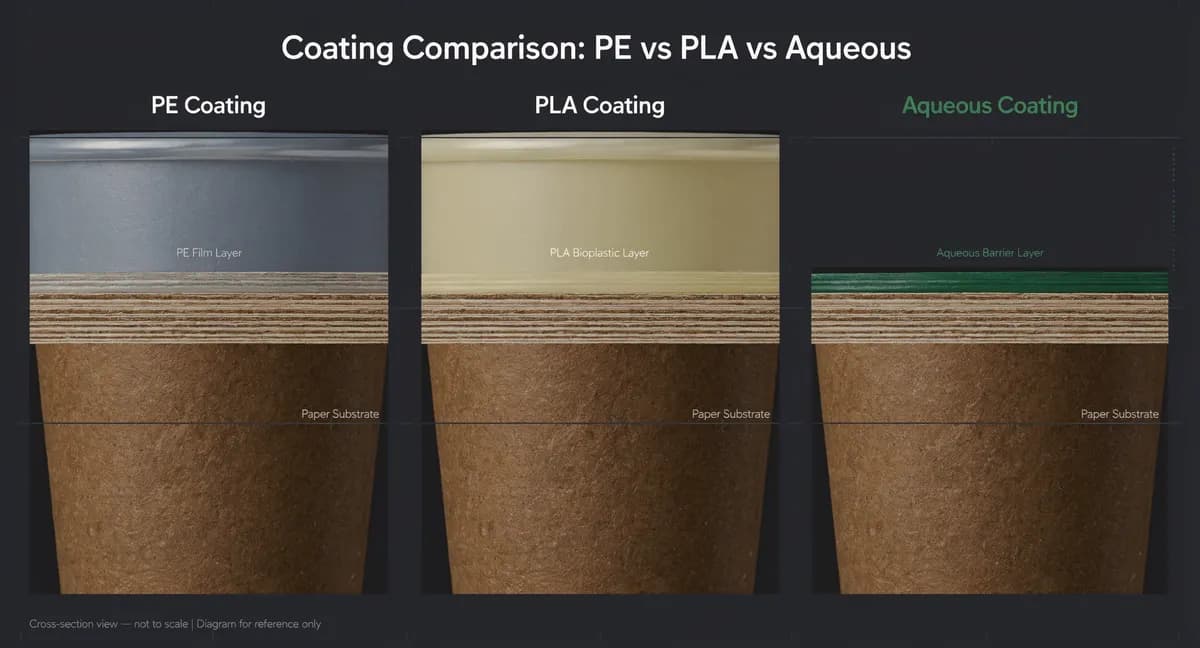
Aqueous coating — a water-based barrier applied to paper — provides liquid resistance without any polymer layer. Aqueous-coated paper cups are:
- Re-pulpable (can be recycled with normal paper waste)
- Verified by CPPRI (Central Pulp and Paper Research Institute, Saharanpur)
- Free of microplastic shedding under standard use conditions
- Compatible with India's existing paper recycling infrastructure
The distinction matters: aqueous coating is not a polymer. It's a mineral and starch-based dispersion that bonds to paper fibers without creating a separable plastic layer. For a full technical comparison of all three coating types, see our guide to PE vs PLA vs aqueous coating.
The Bottom Line
PLA is a polymer marketed on its origin story rather than its end-of-life reality. For Indian businesses making packaging decisions, the question isn't "where does the material come from?" — it's "what happens to it after use in India's actual waste infrastructure?"
If your PLA cup ends up in a Lucknow landfill, it behaves like plastic. If your aqueous-coated cup ends up in a paper recycling unit, it behaves like paper. That's the only distinction that matters.
References
- European Bioplastics. (2022). "Industrial Composting Conditions for Bioplastics." Technical Report.
- Zimmermann, L., et al. (2023). "Microplastic Formation from PLA Under Environmental Conditions." Environmental Science & Technology, 57(12), 4894–4903.
- Centre for Science and Environment. (2023). "State of Composting Infrastructure in India." CSE Report.